Reading 1
The Death of Postmodernism And
Beyond
Alan Kirby's argument that postmodernism has been superseded by "pseudo-modernism" is a compelling and timely critique. He convincingly shifts the debate from purely academic philosophy to the realm of lived cultural experience, highlighting how new technologies have fundamentally altered the relationship between author, text, and audience. His central thesis—that interactivity (clicking, voting, downloading) now defines cultural production—effectively captures the shift from postmodernism to the physical.
However, the essay's strength is also its weakness. By defining pseudo-modernism through its most vapid examples (Big Brother, trivial text messages), Kirby presents a dystopian view that may be premature. He dismisses the potential for these new forms to produce meaningful art, overlooking how creators are already adapting these tools for sophisticated expression in video games, interactive fiction, and complex television narratives. Furthermore, his declaration feels absolute, potentially mistaking a significant cultural shift for a complete paradigm replacement, when in reality, postmodern scepticism often coexists with and critically interrogates these new pseudo-modern forms. Ultimately, while Kirby powerfully diagnoses a new cultural anxiety, his conclusion that it has created a "cultural desert" seems more a provocative lament than a definitive judgment.
"after death experience"
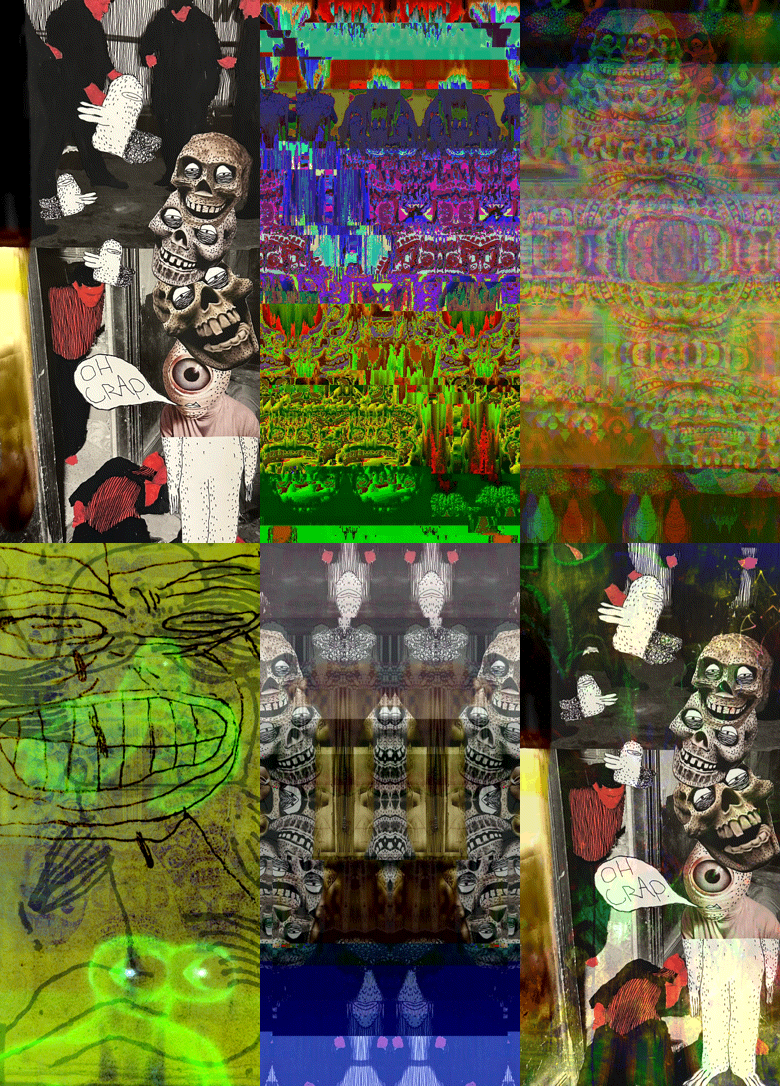
Artist statement 1
This digital collage GIF explores the porous boundary between death, perception, and transcendence. Using looping motion as both rhythm and repetition, the work evokes the cyclical nature of consciousness—its dissolution and rebirth. The laughing skulls serve as symbols of both decay and liberation, mocking the human fear of mortality while embodying the ecstatic dissolution often described in near-death or DMT experiences. Their laughter becomes a paradox: unsettling yet freeing, grotesque yet joyful. The background—a fragmented newspaper clipping of a murder—anchors the piece in the material world, the collective narrative of violence and mortality that shapes our understanding of death. By juxtaposing this with psychedelic imagery, the collage destabilizes the viewer’s moral and emotional footing. The result is a tension between the brutality of human reality and the possibility of transcendence beyond it. The work’s digital format reflects how consciousness itself may flicker—data looping, visual noise, repetition as resurrection. It asks whether our perceptions at the threshold of death are merely chemical illusions or glimpses into a broader continuum of existence. Through the interplay of death’s imagery and digital animation, the piece invites the viewer to confront both the terror and humor in impermanence, suggesting that even in endings, there is infinite motion.
.jpeg)
"do you know who you are? "
Project 4 (ai through laughtivism)


artist statement 2
In this series, I turn towards the chaos of our current political landscape and reshape it through satire, discomfort, and visual exaggeration. I'm interested in the unstable narratives surrounding those in power-particularly the figure who dominates American politics and the culture that enables him. Staging an AI-generated kiss between him and Bill Clinton, then manipulating the image through layers of filters, text, and playful iconography, pushes rumor into spectacle and private scandal into theatrical romance. The point is the artificiality of the image: a fabricated intimacy that reflects the surreal nature of modern political spectacle, in which truth, absurdity, and performance are increasingly indistinguishable. This critique is most consistently sharpened in the subsequent works that bodily render Trump through fragmented icons-his comb-over perched atop a sterile PDF silhouette, a form actually meant to echo the predatory implications of his connections to Epstein. By contrast, the last image and its companion piece shift their gaze outward, toward the geopolitical dynamics between the United States and Israel. Here, the trope of the obedient dog and its commanding owner is both humorous and unsettling, distilling power structures that often function beneath the surface of public discourse. I turn to laughtivism not as a means of softening these realities but of more clearly exposing them; humor becomes a lure, a strategy for drawing viewers into the difficult, uncomfortable truths that shape our present moment.
Reading 2
Danae's depiction of the artist as hacker, I find very accurate: artists are not only playing with code, they steer and reshape the very web like digital sailors, like ships made of data. For me hacktivism is an engaging form of creative rebellion. I agree that a "hack" can be elegant and poetic, not just an intrusion, but a Trojan horse of ideas, as Florian Cramer aphorizes. As an artist, this is a lot more powerful than mere protest, it re-engineers, it introduces beauty or glitches or surprises in existing systems, it gets to see things we are used to overlooking.
Hacktivism is particularly essential at this moment, when so much of our lives has migrated to digital spaces, whose invisible forces have gained more power than before. Algorithms rule, data is silently collected, we see a lot of politics on the web. In this context, artistic hacktivism becomes a necessary survival strategy that lets the artist slip through the cracks of the system and show where it fails or when it wants to dominate; a way to regain some agency in an age of so much automation. The future would seem to demand a greater proportion of this challenging critical imaginative energy. It seems that the future would require more than ever the energy of hacker mentality, those vivid experiences that become, in the words of Callahan and Walpole, "a right to be wrong." Before the advent of more complete automation and artificial intelligence, hacktivist artists would get together to pierce the closed boxes and to realize what man, who goes along with such decisions taken by machines, is losing, our humanity and how it could be obtained only by opening the door. Their tasks would be quite the same, to transform, discover and dissolve; their tasks would evolve into neural networks, smart cities, virtual worlds.